
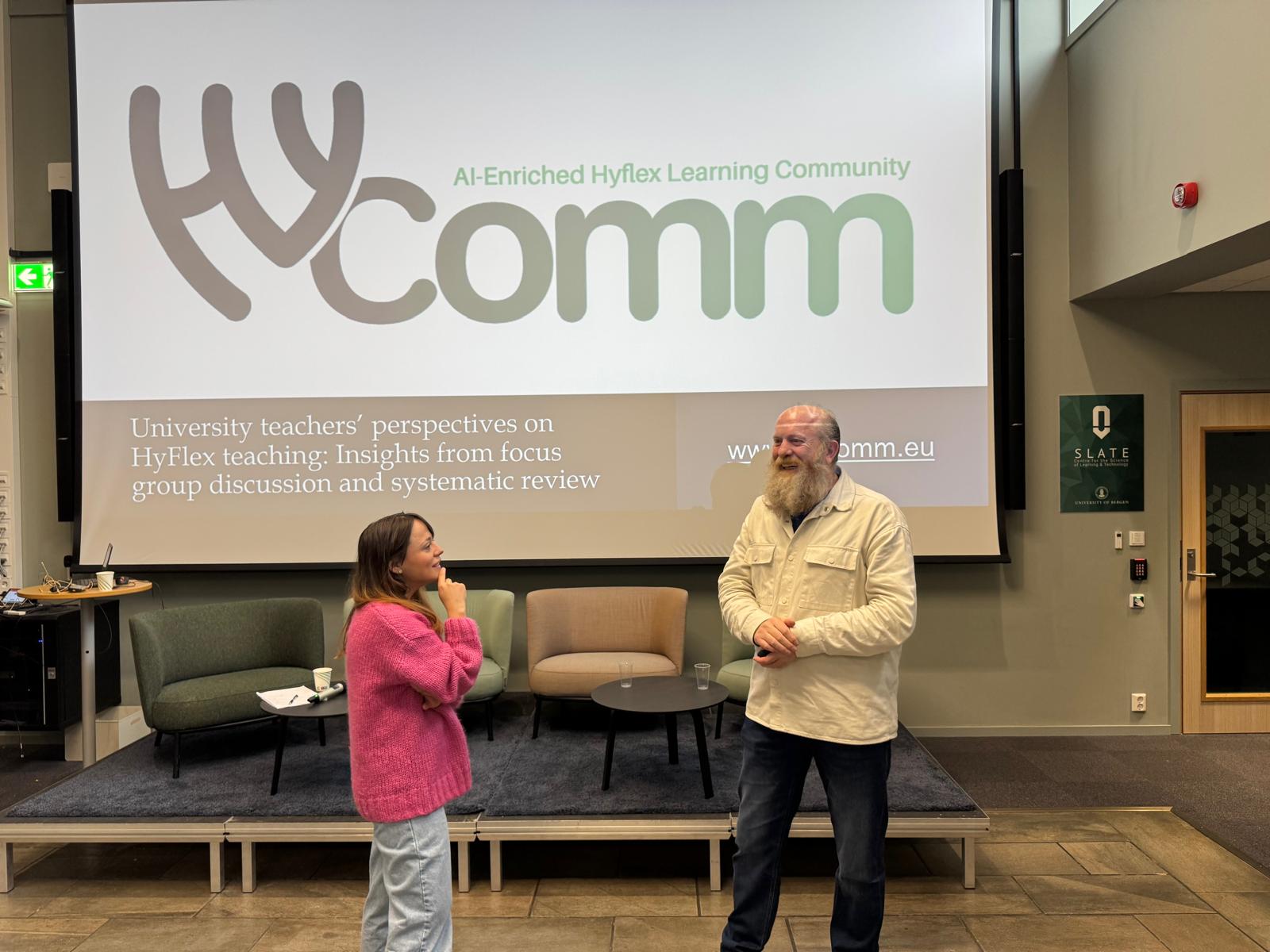
Today, I had the opportunity of presenting our HyComm project to staff at the ‘research day’ held at the Department of Education at the Faculty of Psychology. More than 30 teacher educators and academic developers participated in the session, where I shared our latest results from both focus group discussions and a systematic review of studies on HyFlex teaching.
Our discussion focused on how HyFlex teaching, which combines online and face-to-face, asynchronous participation and allows students to choose their mode of engagement, can promote student agency, autonomy, and inclusion. Drawing on insights from our data, I outlined how HyFlex can benefits for teacher and students as well as highlighting the challenges with a focus on how we could address them when we design Hyflex courses.
One of the most engaging moments came when some participants asked about the distinction between hybrid and Hyflex learning. I clarified that while hybrid courses combine in-person and online elements in a fixed structure, HyFlex designs provide true flexibility, allowing students to choose whether to join sessions in person, online synchronously, or asynchronously.
During the debate led by Lars Petter Storm Torjussen that followed, we discussed whether among other topics, HyFlex principles could be applied beyond higher education. I suggested that ‘since both school and university contexts aim to nurture student agency and autonomy, the HyFlex approach could indeed be adapted to a varying degree and with small steps. Since HyFlex includes opportunities for choice, as recommended in the HyFlex literature, it could encourage students to use that as an opportunity to be motived to learn in the way they want’.
I also stressed that, Hyflex elements could be incorporated at the level of assignment submission in various formats and completing tasks in what the accommodate their needs and expectations.
During the break, participants raised several practical questions:
- Which courses can be designed as HyFlex?
Almost any course that values flexibility and learner choice can be adapted, though not all disciplines or activities fit easily. Starting with lectures or seminars is often a good first step. - How should one prepare to design a HyFlex course?
I emphasized planning asynchronous activities first, then adapting them for synchronous and in-person modes as suggested by Beatty (2019). This approach streamlines the design process and ensures that all modalities are integrated coherently. - How do we synchronize students participating in different modalities?
There are many creative solutions such as using shared online workspaces, collaborative annotation tools, and flexible deadlines that help maintain a sense of connection across modalities. - How do you ensure the quality of engagement across different modes?
Quality can be maintained through intentional design: ensuring every mode provides meaningful interaction and feedback opportunities, rather than simply replicating the same activity in different spaces.
In conclusion, the discussion ended with the idea that while HyFlex requires careful planning and initial investment, it has the potential to enhance inclusivity, support autonomy, and expand participation.
For more about our ongoing work, visit www.hycomm.eu.


